



Stand in most Schomberg backyards and the first thing you notice isn’t the yard, it’s what’s past the fence: a paddock, a riding ring, open pasture running to the treeline. Pergola building in Schomberg has to answer to that view, not fight it. A structure sized and positioned wrong will block the exact thing the homeowner bought the property to look at. Captain Handy builds for that reality on both the heritage lots inside the village and the acreage estates surrounding it. Work and a free estimate request.
Two very different Schomberg properties, one contractor
Inside the village, on the heritage main street, you get century homes on modest in-town lots where a traditional cedar structure sized to match the streetscape makes the most sense. A few minutes outside the village, the lots stop being lots and start being acreage: working or hobby equestrian estates with barns, riding rings, and paddocks that define the property far more than the house does. Pergola builders in Schomberg who only know one of those two settings tend to get the proportions wrong on the other. We’ve built for both, and we size and place the structure differently depending on which one we’re standing in.
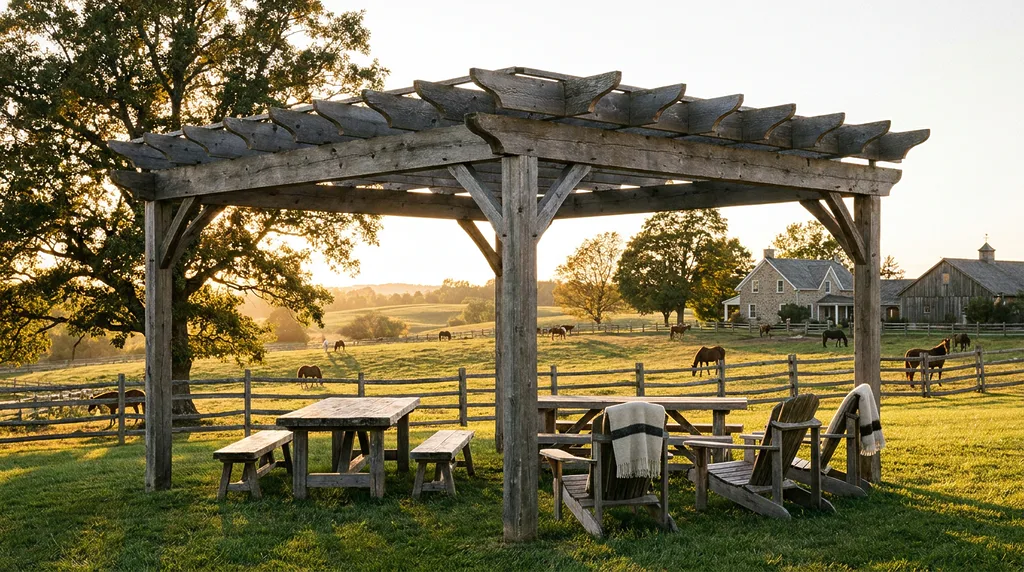
On an estate property, the pergola typically needs sightlines to the barn or paddock built into the plan from the start, because watching the horses from the deck is often the whole point of being outside. On an in-town heritage lot, the priority flips: a smaller, more traditional structure that respects the streetscape rather than announcing itself.
This is why pergola building in Schomberg doesn’t really have a default size or style the way it might in a subdivision. A modest structure sized for a village cottage lot and a wide estate-scale build meant to anchor a long view both get the same care in the footings and framing, because the land dictates the scale here, not a catalog page. Cost to build a pergola in Schomberg follows the same logic: a village lot job and an estate build with several times the square footage aren’t going to land on the same invoice, and we’d rather walk the property first and quote what’s actually needed than hand out a flat number that doesn’t match the site.
What actually changes the price and the plan out here
Rural acreage brings site conditions a city lot never does. Septic systems, wells, and sometimes agricultural drainage all need to be checked before we set a single footing, and access can mean a long gravel driveway or a gated entrance that a crew unfamiliar with rural properties might not plan for. We confirm all of this on an actual site walk, never off a written description or a satellite image.
Weather matters more here too. Out past the village, you’re dealing with real rural Ontario exposure: heavier snow load, open wind across cleared farmland, and none of the urban heat-island effect that keeps city temperatures a few degrees milder. Every frame we engineer for Schomberg accounts for that directly, not a generic city-rated spec applied to a country property where it doesn’t hold up. Footings still go below the frost line no matter what part of King Township you’re in, but on an open lot with no windbreak from neighboring houses or mature bush, we also size the posts and bracing with that extra wind load in mind rather than defaulting to a standard suburban spec that was never engineered for open farmland in the first place.
Materials that belong on a working rural property
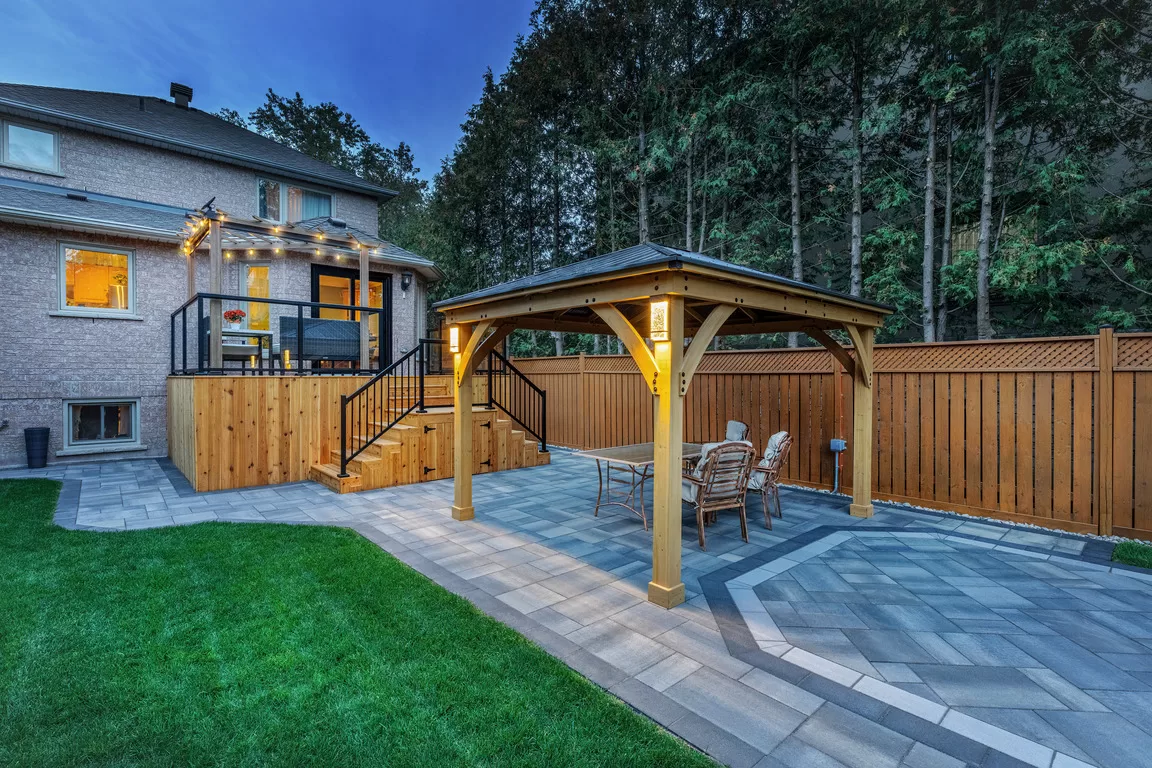
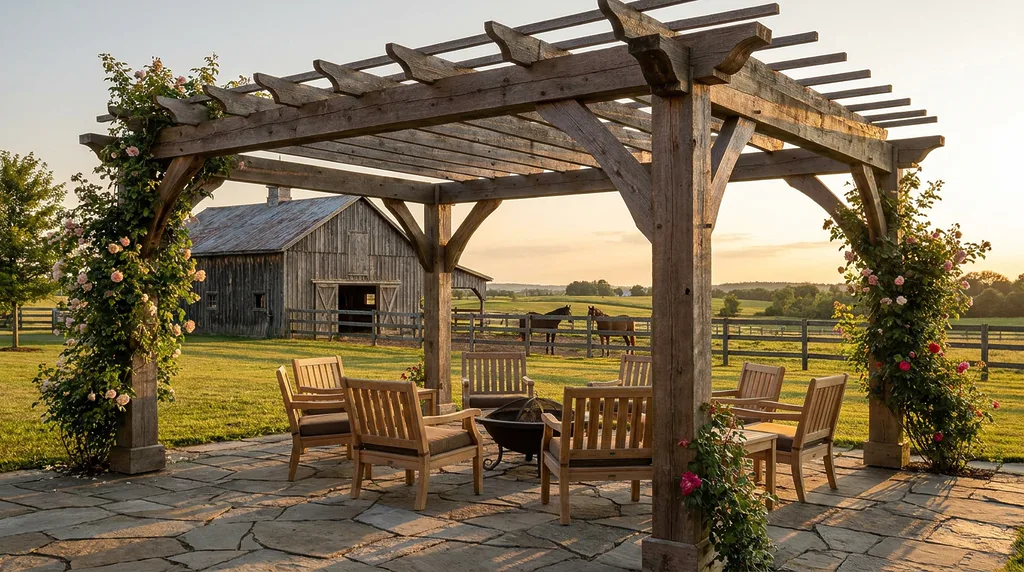
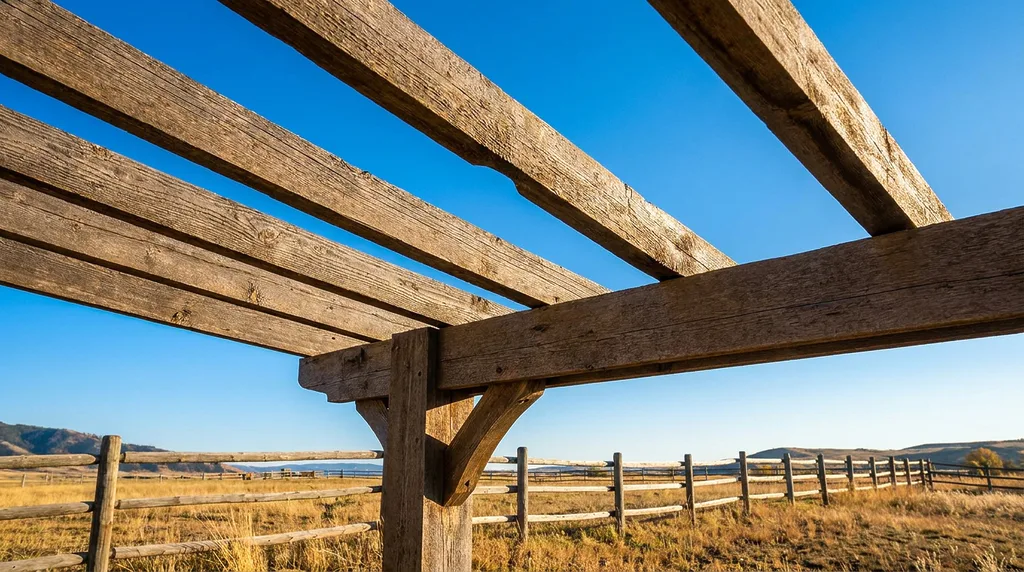
Cedar is the natural fit for horse country. It sits comfortably next to barn wood, board-and-batten siding, and the split-rail fencing already on most equestrian properties around here, and it’s the material we recommend most for pergola building in Schomberg when the goal is to match the existing aesthetic. Pressure-treated wood is the practical answer for larger, more utilitarian structures near a barn or riding ring, offering real structural value at a lower cost than cedar when the priority is function over polish. Powder-coated aluminum suits homeowners who want the countryside look without the maintenance calendar, since it holds up to open rural weather without warping or needing annual staining. On the biggest estate properties, a steel frame lets us clear-span a wide patio or pool area without extra posts breaking up a long sightline across open land. And a motorized or louvered roof is an increasingly common ask on estate builds, since it lets you close up fast when a rural storm rolls in and open back up the moment it passes.
Every project, whatever the material, starts as a custom pergola design specific to the property, in-town or acreage, and every proposal includes a 3D pergola design rendering so you can see how the structure reads against your actual land before we finalize anything. Vinyl comes up less often out here than it does in the suburbs, mostly because homeowners buying acreage tend to want a material that reads as genuinely rural rather than a maintenance-free plastic finish, but it’s still an option for anyone who wants the low upkeep without the higher aluminum price point.
Attached to the farmhouse or freestanding over the paddock
An attached pergola ties into the rear wall of a farmhouse or country home, engineered to tie into the existing roofline without voiding your roof warranty. A freestanding structure is more common on the larger estate lots, often positioned to frame a view of the paddocks or open countryside rather than simply extending the house outward. For properties with an existing stone or gravel patio, we build footings around what’s already there instead of disturbing established landscaping. Backyard pergola building in Schomberg, in the end, comes down to how the land is actually used day to day, whether that’s family entertaining close to the house or a quieter spot positioned purely to take in the view. Pool pergolas come up on the larger estate properties too, usually positioned to shade a seating area beside the pool rather than sitting directly over the water, which keeps maintenance simpler and gives the structure a longer service life.
Permits: Township of King, plus rural clearances
Schomberg falls under Township of King building permit rules, and rural properties often need additional clearances around septic systems and wells, plus conservation authority review given how much protected moraine land runs through King Township. Captain Handy manages the entire permit and approval process, including any extra documentation needed for agricultural or estate-designated land, so you’re not the one tracking down paperwork from three different offices.
What it costs
- Pressure-treated wood pergola: approximately $36-$62+ per square foot installed
- Cedar pergola: approximately $56-$96+ per square foot installed
- Aluminum pergola (fixed roof): approximately $76-$122+ per square foot installed
- Motorized louvered pergola: approximately $132-$222+ per square foot installed
Larger estate-scale structures near a barn or riding ring get quoted individually, since the spans and the site access both affect the number. Call +1 (647) 830-4834 or email [email protected] to get a site visit on the calendar.
Building around a property that’s still working
A lot of Schomberg properties aren’t purely residential, they’re small farms or equestrian operations that keep running through construction. Tractor, trailer, and horse trailer access usually has to stay open the entire time, so we plan footing placement and material staging specifically to stay out of the way of the daily routine, not just around the finished structure.
Sightlines get treated differently here than on a typical suburban job. A city homeowner usually wants a pergola for shade and privacy first. A Schomberg client on an equestrian property often wants the opposite: an unobstructed view toward the paddock, the riding ring, or the barn, because watching the horses is part of what living there is about. We plan post placement and roof height around preserving that view, not around a default privacy screen nobody asked for.
Seasonal use follows the farm calendar more than the retail calendar out here. Foaling season, riding season, harvest, these shape when a family actually wants to be outside, and a motorized or louvered roof earns its cost by stretching real usable time across more of that calendar instead of just the handful of peak summer weekends a purely decorative structure would cover.
Why Schomberg calls Captain Handy back
We’re licensed, insured, and WSIB compliant, and the crew on your build is our crew, not subcontractors we hand the job to and lose track of. On a rural estate, that consistency matters: the planning around access, site conditions, and structural engineering for real snow and wind exposure has to be right before construction starts, and an outside crew unfamiliar with rural properties can miss something a local team catches immediately. You get a written contract, a realistic timeline, and someone who answers the phone, from the first site visit to the final walkthrough. Reviews are at google maps.
We also find that a good chunk of our Schomberg inquiries come from someone who watched a neighboring farm’s pergola go up over a couple of weeks and asked around about who built it. Word travels fast in a small township, and a rushed or poorly engineered job doesn’t stay quiet for long out here any more than a well-built one does.
Past Schomberg, we build across Toronto, North York, Scarborough, Etobicoke, Vaughan, Markham, Richmond Hill, Mississauga, Brampton, Oakville, Thornhill, Aurora, Newmarket, King City, Caledon, Milton, Burlington, Whitchurch-Stouffville, Pickering, Ajax, and Oshawa, and that rural-site experience carries into every King Township property we’re called to, village lot or working estate.
Whether you’re on a quiet street near the village or acreage bordering an active horse farm, call us and we’ll walk the land with you before we talk numbers. If you’ve searched pergola builders near me in Schomberg and gotten mostly city-based contractors who’ve never quoted a rural property, that’s usually the gap we end up filling.